moynat-1

Moynat could justifiably claim to be the world’s most luxurious bag maker, but it doesn’t. It is both historic and brand new. It is owned by the greatest luxury tycoon in history, who doesn’t talk about it. Darius Sanai gets an exclusive insight into the luxury brand of the future with its CEO and its creative director in their Paris flagship store

“Luxury is the time taken to make something. It’s about the effort put in to every element of making something, it’s not just about a label or a brand. It’s about taking it to the limit of the best that I can be proud of.”

Ramesh Nair is talking animatedly in a hushed boutique on the Rue St Honoré in Paris. If luxury were a religion (and it might be) the St Honoré would be its equivalent of the Vatican: where pilgrims the world over come to worship. The striking, sweeping boutique we are in, with its open, circular design and leather goods displayed as artworks on plinths and up walls, is metres from the global flagships of Hermès, Louis Vuitton, Goyard and Chanel.

Nair’s colleague Guillaume Davin takes up the thread. “From the very beginning, we felt the object had to be beautiful, so beautiful. This house is only about superior craftsmanship; we concentrated on the product and only the product because that was all there was.”

For Davin, a former highly successful marketeer, this is a striking statement in itself. But everything about Davin and Nair’s business is striking. We are at the flagship (and to date, only) store of a very particular luxury brand, Moynat. And if you haven’t heard of Moynat yet, prepare to be very surprised.

The heritage archive trunks are displayed alongside the modern-day creations

The heritage archive trunks are displayed alongside the modern-day creations

Wander up to the Moynat store on the Faubourg St Honoré unaware, and you would be forgiven for being a little intrigued, or even confused. You would be correct in assuming you hadn’t heard of it because it hasn’t spent a cent on advertising or product placement: which puts it among numerous tiny niche brands trying to carve a place out for themselves in a growing market with limited budgets.

But the huge, striking storefront on the most prime piece of retail real estate in the world is not something that a niche brand could possibly contemplate. Equally, the artistry and the scale of the shopfit and arrangement inside seems too perfect, more museum of contemporary luxury, than something a non-advertising niche brand could manage.

Take a closer look at the goods on display. Pick up one of the signature Pauline bags, for example. The leather is lustrous, thick, unblemished, perfectly grained, and all of one piece. The detailing shows the bag is plainly hand-made, and yet it is also perfect, minimal, classic contemporary. No niche operation could source leather of what is plainly Hermès standard, in unmarked single pieces big enough, and find the craftsmen to create them.

And yet everything about Moynat’s marketing, or lack of it, is entirely niche. It is not affiliated with any other brand; it sells through word of mouth only; it has no ambitious store opening program, and not a single celebrity has been given one of its products. Somehow, though, uber-model Natalia Vodianova and Chanel creative guru Karl Lagerfeld both proudly display their Moynat bags.

For Moynat is the new private brainchild of Bernard Arnault, Chairman of LVMH, the world’s biggest luxury goods conglomerate and unarguably the most important luxury tycoon in history. Arnault owns Louis Vuitton, Dior, Marc Jacobs, Givenchy, Lanvin, Bulgari, Loro Piana, Dom Perignon, Veuve Cliquot, Château Cheval Blanc and numerous other brands at the top of the luxury tree (most of them through his holding in the LVMH parent company).

But Moynat is different. Conceived in 2010, launched in 2011, but dating back to 1849, Moynat is a trunk and bag maker — a malletier, in French — taken by Arnault, privately, and revived and relaunched by him for the 21st century. It is, plainly, a vehicle for Arnault to conquer the very highest peaks of the luxury market, currently claimed only by Hermès, the family-owned company he would love to get his hands on, but can only (currently) hold on to a 23.1 per cent stake in. Moynat is the attempt by the greatest entrepreneur in luxury to create the most rarefied — not the biggest, or the best known, or widest-selling, but simply the best — brand in luxury.

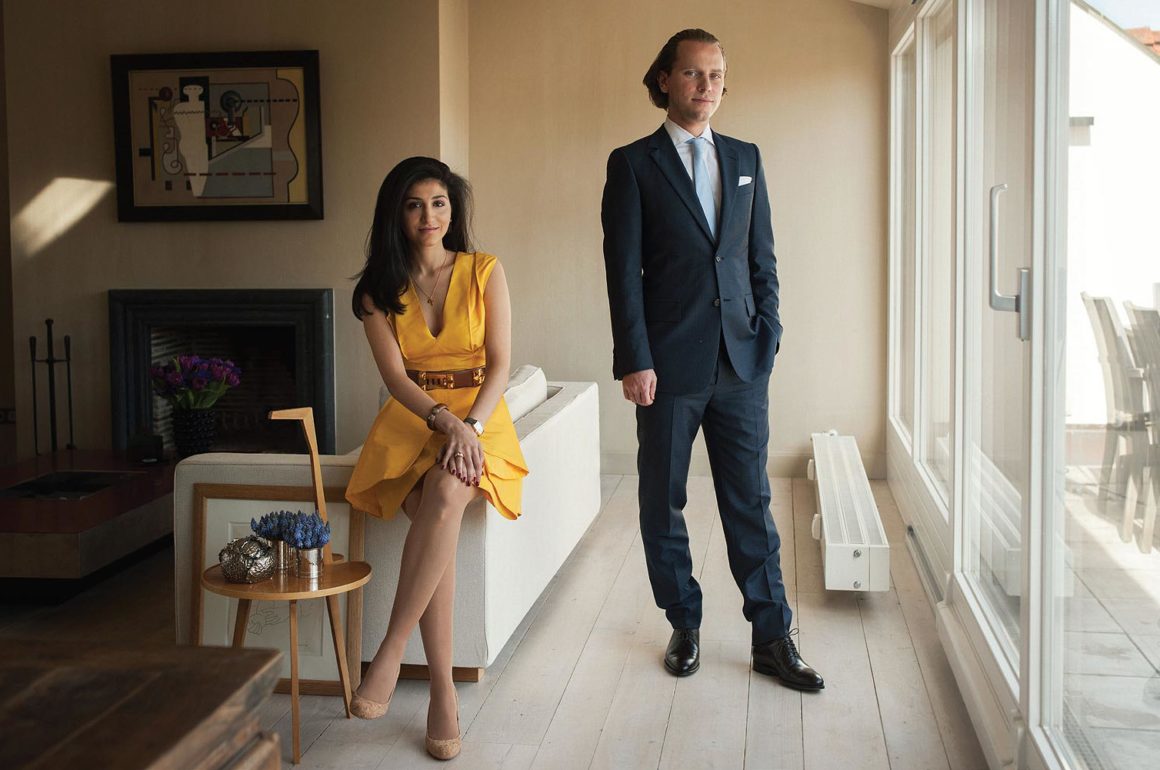
Nair and Davin are leading the charge for Arnault. Nair, formerly of Hermès and Maison Martin Margiela, is the creative director, charged with oversight of the designs and the small atelier in the French countryside where Moynat products are currently made. Davin, as CEO, is in overall charge. Formerly the highly respected director of Louis Vuitton in Japan, he says he had left LVMH when a call came out of the blue from Arnault.

Moynat re-opens its doors at 348 rue Saint Honoré

Moynat re-opens its doors at 348 rue Saint Honoré

“The very beginning for me was Spring 2010, when I got a first call from Monsieur Arnault, and he said he wanted me to come to Paris to see something,” says Davin. We are sitting in the salon privé of Moynat on its upper floor, enclosed from the tide of luxury on the street outside.

“He was not very…he did not disclose the name, he did not disclose the project, it sounded like a precious house or a little gem, and he had just bought the name. And he was undecided about doing something, but he wanted to just share some of the elements about the archives of the house.

“So I came to Paris to see what he had to show, and of course I did not recognise the name. Moynat was really a forgotten house, and only trunk and vintage car collectors knew about the house. They also had one concave-based trunk (in the archive), and you know, I had spent a few years at Vuitton and I had never seen this. And then I heard the house was founded and run by a woman, I started understanding the feminine side of the trunk, and I felt, oh, there is something different. And the fact that the house was a bit older than Vuitton or Goyard was also very interesting.”

Arnault had bought the name and archive of a defunct Parisian trunk maker, so long gone that not even his own directors at Vuitton knew its name: but Moynat had proper heritage. In the Belle Epoque era of the early 20th century, archives showed it was one of the most desirable trunk and bag makers in the world. “It started with a little atelier in 1849,” says Davin. “In 1854 — that’s before Louis Vuitton is even created — Moynat patented a waterproof trunk using materials from Indonesia.”

Nair takes up the tale of the creation of the modern Moynat from when he joined, recruited by Davin in 2010 from a senior craft position at Hermès. “It all seems to be a bit of blur now! Monsieur Arnault wanted to open the store at the end of 2011, so we had just a year to work everything out. So I had to quickly come up with something, study as much as possible, collate the archives because we really didn’t have anything much, so I feel that we needed a strong base, we needed the roots to really come up with everything and be authentic.

“I’m a minimalist, and I find ideas everywhere. For instance, Pauline (the signature bag) became the profile of a trunk… I, a purist, I prefer going towards high-end leathers; I love leathers, I love skins, I love the textures and the odour, so I’m more into high-end leather. And of course our construction is really, really, really good. (With my background at Hermès) when you’ve studied with the best, you cannot take a step downwards, it’s very difficult. And it’s a question that which I used to ask myself at Hermès, was ‘What next?’ Quality is something which really fascinates me; there are times when I’m still not happy enough, I still want to keep pushing, to see what more I can do.”

And were they confident from the start or were they nervous about creating a new brand for a boss as demanding as Bernard Arnault?

“We still are nervous,” says Nair. “It’s a market which I would say is almost saturated, and you’re trying to battle, I mean whatever has to be done, has been done. So you’re just reinventing the wheel, and yes, we’re always nervous. But I always feel that if you go high in, if you go with what we call the know-how, the workmanship, the savoir faire, and excellent quality, I don’t think there’s a reason you could go wrong.”

Moynat opened its first boutique in 1869 at 5, place du Théâtre Français

Moynat opened its first boutique in 1869 at 5, place du Théâtre Français

I suggest that it is unusual for Bernard Arnault, the undisputed emperor of luxury marketing, to launch a brand with no marketing at all. They both smile slightly wryly in agreement, before Davin suggests that Moynat is more a labour of love, a personal passion, a creation for the history books, for Arnault than it is another money-spinning venture.

“It is quite mysterious to people, that Monsieur Arnault is not talking about it at all. He never made any announcements, yet he keeps us under his wing. He calls like twice a day, but it’s the tiniest business he has.”

Is it about a personal desire from Arnault to create something that is simply the very best? “We think so,” nods Davin.

“It’s also I think like his little baby, and his little experiment,” says Nair. Presumably, I suggest, they have access to the vast expertise of Louis Vuitton and the rest of the LVMH group in terms of leveraging suppliers, craftspeople, sourcing hides…

“Nothing. Nothing. Nothing,” says Davin, as emphatically as one can in a hushed private space. “Even on the materials, the leather… we are on our own!” In fact, they say, it works the opposite way: some of the materials and techniques Moynat is using are so high-end and so original that they are filtering down into the LVMH brands.

“It was not like Monsieur Arnault ever pushed this and said, let’s open a store every 10 months. In a way …it’s a different M. Arnault I see here,” says Davin.

Because it’s a personal project?

“It’s a personal project. It’s very small. And he wants to take it step by step.”

Nair adds, intriguingly, “And I think also, for (Arnault), I would say, it’s the very first campaign that he’s starting from zero. A luxury house which is his own creation effectively, so he’s also interested in a very personal way, it’s almost like a baby. It’s interesting, he would see a bag and he’d say is this really good quality? Where is this leather from? Things you normally wouldn’t find a CEO asking, and he’d really be interested in knowing where the leather came from, in a certain type of finish…”

“It is a luxury startup,” agrees Davin, “but it is also for him a piece of savoir faire, a piece of the French patrimony. He is very interested, really going into questions like should the edge be a bit thicker or slimmer, or how do you polish it. He’s incredibly in tune with the little details, and these are questions, because we are so small, we can adjust from one product to another product. Ramesh will say oh let’s do a contrasted edge, or let’s do same coloured edge, and we can adjust and show different things, because it’s one craftsman doing the bag from A to Z, so if we want to just ask a different colour combination we just do one unit.

In an interesting insight into the modus operandi of the LVMH chairman, Davin points out that while Arnault is interested in the product detail of Moynat, this is not unusual.

“I have known him for a long time; I was in cosmetics (as head of Dior cosmetics in Japan), and when he was coming to Japan, we had a little lab, and he was always coming and saying ‘try using this… don’t you think this is still a bit sticky?’, or whatever. He was smelling things, he knew about it, he is obsessed with products, and the weight of the packaging. I think that one of the reason why he is so successful today, is that he has an incredible eye for products and quality. I mean, yes, Hermès is supreme quality, but I think M. Arnault has a sense of this.

“And it’s true at the same time he’s leading a group that now have so many brands, so I’m sure some times of the day he’s also focusing on other elements of the company, but he is completely driven by products and stores. He’s obsessed with what the client sees and touches. You know, when he was coming to Japan he was coming three days, and it was two and half days visiting stores and touching products. And business reviews was one hour for three brands — three hours, then finished. The numbers he can access them any time. It’s all product. Stores. And he has an opinion on absolutely every single piece, you know if he feels it’s a bit too matte, or if it’s a bit too shiny, or if there is a powdery feeling he does not like he will tell you, ‘are you sure about this? Try to show me something different next week’. I think there would be no success (for LVMH) if he was not completely obsessed, he knows that product quality is essential. So we try not to disappoint him on this that’s for sure!

moynat-5

“And with Moynat, Monsieur Arnault doesn’t want to advertise, he doesn’t even want us to communicate, he wants to concentrate on the products, on the atelier, on hiring more craftsman, he’s more obsessed with this — that if the product is right, the house will be right.”

And what are the products? The signature product for women (they don’t describe it as such, but it is plainly so) is the Pauline bag which comes in various sizes and can be bespoked in any colour you like; the Rejane is a smaller city bag, the Quattro more of a super-luxe tote. For men, the curved Limousine cases (as purchased by Karl Lagerfeld) are the standouts, in various sizes and styles. Up in the workshop, I also saw a couple of one-off works in progress, attaché cases and portfolios, not yet released, but which looked sublime.

moynat-6

And where, I wonder, are their clients from, these highly-well-heeled, highly knowledgeable customers who are so sophisticated they wish to carry a brand nobody else will recognise? “The number one nationality is the Americans,” says Davin, “but Asia is also a very big proportion. Japan is probably around 10- 12 per cent, South Korea is six or seven percent, Greater China (including Hong Kong) is around 20 per cent but mainland China is quite small, but South East Asia is big. Indonesia, Malaysia, Singapore, the Philippines. It is all word of mouth.”

And will Moynat remain the luxury world’s best-kept secret? There was a pop-up at the Galeries Lafayette in Paris this summer, and there are unconfirmed rumours that the brand will open a second and even a third store somewhere in the world in 2014. “We cannot accelerate, we are doing everything we can to hire craftsmen, to train them, but this will take time,” says Davin. “We hope that Moynat will really be a beautiful house in 10 years, or 20 years. I am not sure Monsieur Arnault is joking when he says it’s for your grandchildren.”

A privately-owned luxury house sitting atop the world of leather goods and bags, passed down the Arnault family from generation to generation, whatever happens to the megabrands of LVMH. That would be a legacy. And you can witness its birth now, on the Rue St Honoré. Just don’t tell anyone.

Share:
Reading time: 13 min
Former Exhibitions - ‘Van Gogh, Dreaming of Japan’ and ‘Jackson Pollock and Shamanism’ were about transversality

Former Exhibitions – ‘Van Gogh, Dreaming of Japan’ and ‘Jackson Pollock and Shamanism’ were about transversality

This autumn, Singapore hosts two notable events: a Formula One Grand Prix, and the Pinacothèque de Paris’ first ever pop-up museum in the region. Marc Restellini, the owner of the fabled museum, talks us through its collection and his philosophy

“A museum must not become a cemetery.” André Malraux’s remark underlines a fear, which unfortunately, has been well-founded for years, not only in France, but also all over the world.

Marc Restellini - The academic and Modigliani scholar owns and runs the Pinacothèque de Paris

Marc Restellini – The academic and Modigliani scholar owns and runs the Pinacothèque de Paris

His statement raises a fundamental question: what becomes of an artwork once it has left a collector’s walls to take its place in a museum? Whether they have donated, sold or loaned artworks, collectors are the wellsprings of museums. The Louvre, the MoMA, the Hermitage or the NAMOC for example, there is no museum in the world that has not come into being by virtue of private collections.

I have never ceased to wonder why an artwork loses its power as soon as it is exhibited in a museum. Being fortunate enough to have seen the works in the collectors’ homes and being stunned by their splendour, I cannot understand why, when I find them years later inside a museum, that they have lost that magic, that aura which I found in them previously.

Is this the fear that Malraux tried to express? He was, after all, an enlightened art lover who knew collectors so intimately, and who was for so long the head of the French museums as the country’s first Minister of Cultural Affairs from 1958 to 1969.

But what is a museum? In the past, collected objects were kept and exhibited privately. The great collectors such as Barnes, Morosov, or Chtoukine, just to mention some of the best-known, allowed public access to their collections once a week. Is the private museum not an extension of the Curiosities Cabinet? The Curiosities Cabinet first emerged during the Renaissance and was a place to house collections of a variety of objects. The term ‘Chamber of Wonders’ was used later for collections that primarily held works of art. Curiosities Cabinets finally disappeared in the 19th century when they were essentially replaced by museums.

Pinacothèque de Paris,  The art gallery is located at place de la Madeleine, in the 8th arrondissement of Paris

Pinacothèque de Paris, The art gallery is located at place de la Madeleine, in the 8th arrondissement of Paris

The idea today is to bring back everything the museum had lost of its essence and meaning. Indeed the name of the museum that will open in 2015 in Singapore is called La Pinacothèque de Paris. Etymologically, ‘pinacothèque’ means ‘box of paintings’, and connotes intimacy and secrecy. To provide visitors with a taste of what is to come when the Singapore Pinacothèque de Paris officially opens, a pop-up exhibition will open this year on 14 September. Entitled ‘The Art of Collecting, Masterpieces from the Pinacothèque de Paris’, the exhibition will span over five hundred years of art history through prestigious works of art by 20 world-famous artists including Botticelli, Rembrandt, Van Dyck, Monet, Renoir, Modigliani, Picasso and Chu Teh Chun among others. The museum in Singapore will mirror that of France, a fine art museum known for its critically acclaimed exhibitions that celebrate transversality and the dialogue between different works of art.

‘Transversality’ is a term that goes some way towards explaining how a small, timeless, community of artists, from all periods, cultures and origins, are united by a similar way of thinking and behaving. By its encyclopaedic approach, every museum tends to make us forget its main role: to ensure that the works stay alive. They all speak of beauty, have identical references and the same historical narrative. But these works have to be placed together in order to set up a dialogue — beyond borders and periods — for they summon up what we all have in common.

Pablo Picasso Jacqueline, Undated

Pablo Picasso, Jacqueline, Undated

That is why, for the first time, I have chosen to show works together without classifying them by period or artist, or even by category like in other museums. By combining them according to my sensitivities and with an iconographic, and aesthetic logic, I have attempted to re-establish the original dialogue found within the art lover’s cabinet, that timeless place wherein the works can converse, dialogue and come to life again.

So forget everything you have been taught, or all you have not learned; let yourself go with the intermingling, the combinations, and try to find the keys you are offered in order to hear the works speaking to each other. You will enjoy, without any complexes, works that are usually impossible to see side by side. You will see Botticelli, Van Dyck or Renoir representing the worthies in the same way, be they Italian in the 16th century, Flemish in the 17th or French in the 19th century. You will also notice that Botticelli and Pierre de Cortone’s circle saw religion in an identical way; and that the landscapes by Picasso, Monet and Ruysdael were constructed in the same fashion.

Chaim Soutine The Bellboy, 1927-1928

Chaim Soutine, The Bellboy, 1927-1928

A singular experience in today’s world, a museum exhibition serves as a reminder that understanding can be framed in an attractive and playful manner, as long as one liberates one’s sensitivity. The artworks shall not be contemplated individually, but should be observed together, within their referential aspects. Future visitors of the Singapore Pinacothèque de Paris will be invited to enter the precious lair of a collector’s passion and experience a repository of wonderment and beauty.

Singapore, a country with numerous museums, shows a strong interest for culture(s) and a serious involvement in community outreach and education. That was therefore natural and logic to implement the Pinacothèque de Paris in Singapore. And as a matter of fact, the Pinacothèque de Paris will offer the first network of museums making the connection between Asian and Western art. We are excited to welcome you to our first show in the Red Dot.

About the Pinacothèque de Paris

Pinacothèque de Paris, the largest private art museum in Paris, will open its first venue outside of Europe in Singapore. Set to fully open by the first quarter of 2015, the Singapore Pinacothèque de Paris will be located at the Fort Canning Centre, within Fort Canning Park. Pinacothèque de Paris is well-known for presenting world-class exhibitions by master artists the likes of Rembrandt Harmensz, Vincent van Gogh, Claude Monet, Amedeo Modigliani, Pablo Picasso, Edvard Munch and Jackson Pollock among others. These masterpieces are borrowed from private collections not normally seen in a museum setting and the way they are presented is unique.

Share:
Reading time: 5 min
Stubai Valley - Four family-friendly skiing areas cater to all aptitudes

Stubai Valley – Four family-friendly skiing areas cater to all aptitudes

Jackson Hole or Hokkaido? Courchevel or St Moritz? None of the above, says Darius Sanai, rediscovering a childhood passion for why Austria offers one of the most involving ski experiences of all

For a sport that essentially involves the same thing, namely gliding down a mountainside with your feet attached to fiberglass boards, skiing divides opinions quite dramatically among its connoisseurs. If you play golf, you will more likely than not admire the same courses as other golf savants; mountaineers agree that Nanga Parabat and K2 are likely to exercise you more than any other peak; drivers aspire to the Nürburgring.

But ask 10 experienced and affluent skiers their opinions on where the best place is to ski and you will likely receive 10 opinions. A powderhound might insist on Jackson Hole. A lover of open pistes (and diamonds) will cast her vote for Courchevel. Fans of vertical drops (and gourmet lunches) will urge you to visit Zermatt. Heli-skiing fanatics will go for the Alberta back country; expert ski/socialisers will favour Aspen. And so on.

And they may all be correct, for skiing has so many sides to it, both on the slopes and in terms of what happens before, afterwards and in between. One of the prominent categories of aficionados is the Austria-lover. While this may seem a rather broad church — affiliated to a country, rather than a single resort — it shares a common range of loves, and I have to admit that I am becoming part of it.

To be an echt Austriaphile, you need to satisfy various conditions. You need to be an admirer, and consumer, of that country’s unique tradition of gastronomically high-achieving, comfortable, familyrun, small luxury hotels. These are never part of a chain, and often idiosyncratic, but are run to exacting standards of hotel keeping that would make many a luxury chain blush. They are as precise in their standards as Swiss watches; indeed Switzerland has a similar tradition, although its luxury mountain hotels tend to be bigger, grander, and more generic (and less gastronomic) than the Austrians.

Spa Facilities - Relax in the indoor or outdoor pool with views of the Tyrol mountains

Spa Facilities – Relax in the indoor or outdoor pool with views of the Tyrol mountains

You need also to admire wood-panelled cosiness, in quantities that can sometimes be kitsch, and are now sometimes melded with contemporary chic. You should favour friendly Alpine village-style service over highly trained service staff who could be replicated from an island resort. And you have to tolerate idiosyncracies: slopes that do not link up as well as some of the slickest purpose-built resorts and mountain areas that sometimes require a walk from your hotel (although the advent of ski depots on the mountain has taken the pain away from this element).

I am not new to Austria. I learned to ski there, in the era of long skis and Franz Klammer, and having since skied pretty much the best of Europe, North America and Africa (although not Japan’s Hokkaido, which remains on the must-ski list), find myself irresistibly attracted to it again now I have a family of my own learning to ski. Partly it is because of the superb standard of the Austrian ski instructors; partly it is because the country is so well served by Crystal, the excellent UK ski tour operator; and partly it is for all the reasons outlined above.

And as it is time to be planning your winter’s hit of snow and mulled wine, I can heartily recommend you replicate our own experience last winter; if you are not an Austriaphile already, it is likely to convert you.

Our chosen destination was not one of Austria’s world-famous names (St Anton, Lech, Kitzbühel), but a village (Neustift) in a valley (the Stubaital) that was previously unknown, even to me. The decision was informed by the fact that Neustift has a highly-rated family-run luxury hotel, the Jagdhof, with indoor and outdoor pools; it also has snow-sure glacier skiing at the Stubai glacier, a few kilometres down the valley; and it is amazingly near Innsbruck airport — a mere 25 minute transfer, which, when you have car-sick children to worry about, is a holiday game changer to the three to five hours each way required by many of the big resorts in France.

The Stuben - Enjoy an extensive breakfast spread and award-winning cuisine in the expansive restaurant

The Stuben – Enjoy an extensive breakfast spread and award-winning cuisine in the expansive restaurant

The Jagdhof appeared slightly unprepossessing at first, as it is tucked on a road exiting the village of Neustift; it is only on entering that you realise that its gardens, views and open spaces are on the other side, onto which our room, a family suite in the annexe, fortunately looked. Our balcony was vast, big enough to cross country ski on, and it sat above meadows and parkland covered with thick snow, and a view down the valley towards the glacier on which we would be skiing. The bar at the Jagdhof, where we went every evening for the pre-dinner aperitif, is all alcoves, wooden panels and super-professional bartenders, exactly as an Austrian hotel’s bar ought to be. There was no attempt to mimic urban bar chic in terms of décor, and although there was an extensive cocktail list, we delved instead into the quite superb list of Austrian and other European wines. Occasional wine drinkers may be familiar with refreshing Austrian Grüner Veltliners and fruity Rieslings, but Austria also has an array of distinctive, characterful, soft and layered red wines that don’t see broad distribution outside the country. They go very well with post-skiing evenings, sitting in the intimate restaurant across the corridor from the bar, sipping as temperatures drop outside. Blaufrankish and Blauburgunder from Burgenland, Pinot Noir from the Wachau: these warm but approachable reds also matched the intricate cuisine served in the restaurant. Char, trout, salmon and turbot were fragranced, always perfectly cooked, and nuanced rather than overwhelmed by their accompaniments; lamb was a mountain staple. Desserts were Austrian-sweet and creamy. (One observation: if you are not too fond of dairy, it is worth letting them know, as this is a chef who is fond of his cream and cream-based foams, from the amuses onwards.)

Hotel Jagdhof - Expect traditional Tyrolean hospitality in the five-star hotel

Hotel Jagdhof – Expect traditional Tyrolean hospitality in the five-star hotel

And then, there was the skiing. The Stubaital, or Stubai valley, of which Neustift is the main village, has a number of skiing areas, the most extensive and snow-sure of which is the glacier, at its southern end. The journey to the lifts takes 20 minutes by road and you take the gondola up to the glacier’s hub, you can fan out in a number of directions: everything from nursery slopes to black runs are available.

The children advanced from the nursery area to the longer blue runs fanning around the hub within a day or two; I enjoyed the couple of black runs, although I should note that this is not an area for a group of skiers who only wish to bash the blacks. Some longer reds were exciting also, and the star piste was the 10km (challenging) red run, with almost 2,000m vertical drop, from the top station, through a hidden valley, to the valley station of the gondola. The altitude difference was quite breathtaking, and if you did stop to catch your breath halfway down, you found yourself in a valley with no sign of human hand or habitation (apart from the piste), far away from the lifts and restaurants.

If you are a mixed-ability family or group, and enjoy the convenience of getting together on the mountain for lunch every day and not splitting off from each other for the entire day, the Stubai glacier is one of the best options I have come across in the Alps. There is one caveat: the main gondola serving the glacier is quite old and low-tech, and on a windy day it can close, as happened to us. This is being addressed by a new hi-tech gondola that will open at the start of the 2014 season.

The other areas of the Stubaital are notable more for their cute, tree-lined pistes cutting through the forests (they are at much lower altitude) and excellent mountain huts serving fondues, hearty salads and mountain meat dishes, than their world-beating skiing. For a gentle family meander interspersed with a meal incorporating high-quality ingredients at reasonable prices (I hope the French are paying attention here) they are memorable.

In the end, the blend of traditional warmth, exacting standards, excellent organisation, convenience of transfer, and catering to all standards of skier, is something the Stubaital has down to perfection. If and when our children become experts themselves, we will look elsewhere; but it is heartening to know that varying standards of ski ability do not need to mean an inconsistent standard of holiday.

A number of operators offer five-star packages in Austria; of them Crystal Ski (crystalski.co.uk) is probably the slickest and most experienced. Crystal offers half board at the Hotel Jagdhof including airport lounge passes, flights, transfers, and all the extras you might expect, including the excellent childcare from the kids’ club, which in our experience goes above and beyond the call of duty.

Share:
Reading time: 7 min


Lanvin is a great French fashion house that no longer (since 1992) creates Haute Couture, the most exclusive and bespoke of all the collections. However, some might say the artistry of its revered creative director, Alber Elbaz, makes couture irrelevant. When LUX asked Elbaz for his thoughts on the relationship between the house’s couture past and its high-end readyto- wear present, he gave us these measured — and exclusive — thoughts:

“For the latest collection [Winter 2013], I wanted to take the time for once and to treat it like real luxury. I wanted to go back to the preciousness, to the emotion, to the know-how of the French atelier.

“I wanted to show that couture is an experiment and it’s a laboratory of forms, of shapes, of colours, of fabrics. I wanted to show that it is something that is relevant and you can wear it with flat shoes. I wanted to bring that Parisian French feeling to it, of workmanship.”

“An atelier for me is mostly a laboratory with amazing people that in a few years will be retired. So we might as well enjoy it while it’s there. When I arrived at Lanvin, I realised that the ateliers were the same as the time of Haute Couture at Lanvin. Today, there are still people who have worked at Lanvin for the Haute Couture. This savoir-faire is extremely important. And I have a very close relationship with the people at the atelier. I don’t work with a head of seamstress like the other couture houses usually do.

“I found that it was better to speak directly to the ‘modéliste’ (pattern maker). So I am like the head of seamstress. I work with them every day, speaking of the problems they have on a dress, doing fittings three, four or five times on a model. And the studio is just at the top floor of the atelier, so it is very easy to meet each other. I love these amazing people who help me to realise my dreams day after day.”

Share:
Reading time: 1 min
Nautical Celebrations on Aqua Voyage

Sunseeker – The craft has a capacity of up to 14 cruising guests and comes with three en-suite cabins

Have your private, personal boat party — without having to fuss over the small things. ANDREA SEIFERT shows how

There is something about a sea voyage that lends itself to a celebration. Cruising the water on a luxury yacht is a true escape, and a welcome hiatus from the drudgery of everyday life on land.

So what better way to celebrate my husband’s impending 40th than with an intimate gathering of close family and friends on the water? The occasion needed to be marked with a show-stopping celebratory event, and a tailor-made journey on the sea with luxury yacht charterers Aqua Voyage seemed the perfect solution. With a myriad of options and destinations available, an overnight stay was eschewed in favour of a day trip on a sleek Sunseeker to Riau island in Indonesia. This would allow a full day of Saturday fun without cutting into busy schedules for an entire weekend.

Being a devoted epicurean, the adventure began with the most important aspect of the party – the menu. A consultation with the Aqua Voyage Executive Chef revealed that the culinary aspect of the event could be entirely tailored to personal preference; whether it be full onboard catering by a specific restaurant, or a bespoke menu prepared by Executive Chef Stacey Teo. As this was a day to spoil my better half, we devised a menu with a mixture of his favourite dishes from all around town and a few new surprises thrown in by Chef Stacey.

Wild Diver Scallops

Wild Diver Scallops with Orange Jam, Almonds

We set sail for Riau Island early in the morning, slightly bleary-eyed. Butlers were on hand to serve up decadent, buttery pain au chocolate and croissants from the Joel Robuchon bakery, freshly squeezed grapefruit juice and espressos. Departing from Singapore, the scene was set with a pre-programmed iPod on the stereo system playing soft bossa nova tunes, and mimosas swiftly followed the coffees to get the party going.

The cerulean waters and white sands of Riau island beckoned, and a lazy morning of swimming in the sunshine soon came to an end as the boat docked a lazy dozen or so meters from the beach, just in time for a luxe picnic lunch. There’s nothing better than an assortment of zesty salads in the tropics, and we started with a salad of handpicked crab, avocado, citrus fruits and toasted sunflower seeds from the newly opened restaurant, The Black Swan. This was accompanied by Chef Stacey’s Wild Diver Scallops with Orange Jam, Almonds and Micro-Cress Salad with Egg Dressing. Creamy, indulgent burrata and vine ripened tomatoes followed alongside home-made duck rillete and crusty baguette. The grand finale was my very own famously gooey brownies.

Nothing defines a tropical getaway like a pampering spa treatment. This was a day for sybarite excesses and pleasure, so two therapists from our favourite spa in town were recruited to come onboard and pamper us with aromatherapy oil massages and foot reflexology to ease any work week tensions. A few guests then retreated to the luxurious mastersuite complete with fine Egyptian cotton linen and fluffy duvets for a heavenly post treatment snooze. Given my husband’s provenance, Afternoon Tea at Sea was a given and served in delicate bone china cups with a selection of refreshing herbal Gryphon iced and hot tea, scones with jam and clotted cream, and an assortment of Indonesian tidbits as a tribute to the location.

Dock at the Marina

Dock at the Marina – Ready to set sail for a day out on the seas

Expertly timed fireworks alongside the brilliant scarlet sunset brought the day to a dramatic and triumphant close. Our favourite mixologist from a premium cocktail bar in Singapore had been drafted as a surprise to prepare hubby’s signature drink and arrived onboard to act as our very own flair bartender, dazzling us of gravity defying bottle juggling and glass pouring set to music. The final culmination of the perfect day was a round of our Aqua Voyage cocktails to toast the birthday boy with, and a unanimous group decision, to celebrate many more birthdays on sea.

aquavoyage.com

Share:
Reading time: 3 min

LUX Issue 3 /2013 - The Bespoke Issue

Just launched – The Bespoke Issue

Share:
Reading time: 1 min

By Jessica Bowen

For full style marks this summer have the courage to go bold with super-bright colours and clashing prints

Share:
Reading time: 1 min

So you’ve done Morocco, burned through Bali, and Bhutan is just so yesterday. Take a tour with Caroline Davies of six destinations that are for now – and the future

THE ATACAMA DESERT, Chile

There are few places as serene as a desert at sunrise. The world’s most arid desert, a drive through the Atacama can lead you to volcanoes, salt flats, geysers, natural hot springs, isolated beaches and fertile valleys rich in wildlife. Dotted with colonial towns such as San Pedro de Atacama, the desert is also famed for its clear skies. Combined with the lack of light pollution and radio interference, it is one of the best places in the world for astronomical observation.

Where to stay? Alto Atacama Desert Lodge and Spa. Tucked in a secluded valley alongside the San Pedro river, the lodge’s red sandstone blends into the craggy deep red ridges. And of course, it has its own observatory. altoatacama.com

SYLT, Germany

OK it’s not exactly a discovery, but the German chi-chi classes like to keep this stretch of idyllic sandy haven to themselves. The island sits off Northern Germany in the influence of the Gulf stream, keeping its summer temperatures above those of the mainland. A favourite of the well-to-do, the small island even has its own branch of Hermès and a polo club which hosts beach polo cup games.

Where to stay? Kampen is perhaps the most famous of the 11 villages on the island. Beautiful beaches, broad heaths and a rugged red cliff, the scenery is dramatic and the hotels refined.

KURDISH, IRAQ, Iraq

A trip for adventurers who like their routes untrodden. The region retains a degree of political freedom from Baghdad and surprisingly boasts 5 star luxury hotels and spas – the Marriott, Hilton and Kempinski are all on the way too – as well as a UNESCO World Heritage site. In fact, the ancient city of Erbil was named 2014’s tourism capital by the Arab Council of Tourism. Castles, churches, monuments and archaeological sites are all key tourist spots, but few sites beat Gali Ali Beg. Also known as ‘the Grand Canyon of the Middle East’, this dramatic lush green ridge provides biblical views as well as rafting and rock climbing.

Where to stay? At present, tourism infrastructure is still in its infancy outside Erbil, so take a tour to see the country fully. ‘Undiscovered Destinations’ provides a good grounding in the harrowing recent history of the country as well as the ancient influences that shaped the region. undiscovered-destination.com

MONTENEGRO

Referred to as the hidden pearl of the Mediterranean, the small state of Montenegro is tucked next to better known Croatia and holds the same beautiful coastline, ready to be explored. Despite the unspoiled mountainous scenery, parts of Montenegro are far from rustic. Porto Montenegro, one of the newest luxury yacht developments on the Mediterranean, houses Versace, Armani, Missoni and Feragamo alongside gleaming mega yachts.

Where to stay? Luštica Bay. After a few days in the noise and the action, retreat to Luštica Bay on the ancient bay of Trašte. No less well catered for, the Bay has a quieter pace than the port and is just a stone’s throw away and holds the country’s first 18- hole golf course. lusticabay.com

MYANMAR

Previously closed off by a military regime, Myanmar, (or Burma), remains relatively unaffected by the trappings of a globalised world. Intrepid travellers are beginning to dip their toes into this mysterious country, although don’t expect fast food restaurants, credit card machines or 3G just yet. The release of Aung San Suu Kyi in 2010 and Obama’s visit in 2012 have made for a more optimistic atmosphere in a country steeped in a fascinating if volatile past.

Where to stay? Orient Express, Orcaella Myanmar. From July 2013, Orient Express will launch its newly built luxury river cruise into the heart of Burma down the Ayeyardwady and Chindwin Rivers. With only 25 cabins on its four decks, the cruise is an intimate way to be introduced to the country. orcaella.net

THE NORTHWEST HIGHLANDS, Scotland

A stay in the rugged highlands can inspire novels and symphonies as aristocrats, royalty and artists have known for centuries, and a new generation of travelling classes is discovering for themselves. Drive through twisting valleys and watch your phone signal and worries drain away as the lochs and purple heather appear. The land of countryside pursuits, you can try trekking, fishing, stalking, mountain biking, white water rafting or clay pigeon shooting. Alternatively, a brisk walk and a wee dram from a whiskey distillery can be just as rewarding.

Where to stay? Alladale, Wilderness Reserve. Follow in the gentry’s footsteps and stay in the main sporting lodge at Alladale. Built in 1877 it is protected by a dense forest of Caledonian Scots pine. You can go helicopter fishing, stalking, shooting, hiking, and even hit the beach. With a roaring fire in winter the drawing room has its own baby grand piano which might get you singing, the array of single malt whiskies certainly will. alladale.co.uk

Share:
Reading time: 4 min
Applying fresh radical applications to indigenous craft traditions sit at the core of Head of State

Applying fresh radical applications to indigenous craft traditions sit at the core of Head of State

Quality and quantity might just be what Singapore needs to be in with the rest of the cool kids in the international fashion arena. Just what kind of quality and quantity are we looking for here? Lucinda Law ‘talk shop’ with some of Singapore’s fashion stalwarts and decide on how Singapore can have it all

A surreptitious makeover is taking place in the fashion industry in the last ten years. While Singapore has certainly touted itself as a shopper’s paradise, more savvy shoppers are turning their heels away from the rapid rise of homogenous shopping malls housing run-of-the-mill high street brands. A new generation of Singapore business owners, artists, designers and visionaries – shoppers – are filling the supply that they have demanded. A more diverse shopping experience made up of concept stores or shopping venues away from the malls, with an increasing range of local design-led fashion products with a focus on quality is upon us.

The hunt for quality amidst the massproduced goods readily found in Singapore gave rise to a number of bespoke services and artisan brands. With almost 25 years of experience in the fashion scene, Kevin Seah, Director of Kevin Seah Bespoke, says he is “targeting men with discerning taste who appreciates quality and well-made products.”

Carolyn Kan, Founder and Designer of Carrie K. Artisan Jewellery, is toeing the front line for quality in Singapore. The former Managing Director of M&C Saatchi started her jewellery line in July 2009 and in 2011, launched KEEPERS, an artisan showcase bringing together independent designers, artists and artisans, and lends these brands more visibility. Kan says, “I see a greater appreciation of artisan craftsmanship and bespoke design. I’ve also noticed a growing pool of people who value quality over quantity. So we started KEEPERS to give people an opportunity to learn more from the artisans and independent designers behind the work”. And they come from a range of fashion products, namely bespoke shoes, timepieces and hats.

A more robust fashion economy certainly calls for a more diverse range of fashion products, and as confidence in the industry grows, more cult brands emerge. One such designer is Chee Sau Fen, Founder & Designer, Heads of State Millinery. Chee is a self-taught designer who has worked for more than fifteen years in the visual arts and events industries before starting her own millinery label. It is quite curious to observe that the media release includes a footnote explaining that ‘millinery refers to the art of hat-making’. A consideration on Chee’s part, perhaps due to fact that a local brand dealing in millinery is largely unheard of. Her beautiful sculptural head pieces are made from traditional handloom abaca fabric of the Daraghuyan Community of the Bukidnon Tribe in Philippines and they are each hand-draped and sewn by Chee.

The three driving forces behind label Mystic Vintage were brought together by their passion for eyewear

The three driving forces behind label Mystic Vintage were brought together by their passion for eyewear

Highly-coverted, never-been-done before, hip and made from utmost quality, brands like Heads of State check all the boxes for the new emerging Singapore labels. Likewise, Mystic Vintage Eyewear, is just one of the brands that understands cool eyewear is part of the complete head-to-toe assemblage in fashion. Mystic Vintage was started in 2008 by Alvin Tan, Jason Tong and San Yin Mei, the three veterans in the design and creative industry were brought together by their passion for eyewear.

A bespectacled, Alvin Tan, who is also part of PHUNK, a famous Singapore art collective, says, “Mystic Vintage is very focused on design and the theme revolving around it. Each model is inspired by a different theme, for eg, Music, Aviation, Magic, etc, and its design relates to that. What’s unique about each design is that the frames have different quotes engraved on the arms of the eyewear, it could be lyrics from a song or a quote from a movie, something that might bring a sense of familiarity to the person wearing it.” Their obsession for details and quality has garnered them a sizeable following and helped raise the bar for cult labels in Singapore and their presence overseas.

Tan adds, “There’s a heightened interest in creating locally and also more awareness for supporting local labels. The market in Singapore is small so many brands might find themselves having to explore foreign markets. We think the fashion industry will grow regionally, creatively and gain international awareness.” Because Singapore is a little red dot, she is immensely conscious of the need to reach out to an international audience, but first, some local attention never hurts and is imperative for the makeover to take place. There has been a longstanding sentiment about the lack of support for local products, but all this is beginning to change.

Ling Wu’s python skin handbags and clutches are all ethically sourced.

Ling Wu’s python skin handbags and clutches are all ethically sourced.

Goh Ling Ling, founder and designer of LingWu bags, a lecturer in Fashion at Lasalle College of the Arts and a veteran of the Singapore fashion scene says, “In the last 10 years, I’ve seen such a dramatic increase of designers developing their own creations; not just fashion but visual artists and designers, jewellery, textile, etc. But for a long time designers in Singapore were having a pretty hard time getting acceptance from people here, and Singaporeans like to compare the local with the international, which can be unfair at times.”

So the time has finally come to do away with the naysayers. Instead, a more enthusiastic and ‘pret-ta-support’ attitude fans the industry.

Samuel Wong, Creative Director of evenodd, a young menswear label says, “Singaporeans now support and buy local designers and is proud of it. There is a significant growth for ‘made in Singapore’ fashion. The media attention and customers patronage have increased.” Wong’s edgy and youthful menswear label is a testament to the confidence among young start-up brands, with a good measure of business sense thrown in.

There is an unprecedented rise of independent fashion labels. Some freshly out of school, but those with prior experience in the creative industry are helming the fashion industry.

The message is loud and clear: We are doing it ourselves and we are doing it our own way.

Mash-Up, an independent street-wear label is just one of the brands that is echoing this zeitgeist. Daniel Monasterios Tan, Nathanael Ng and Shaf Amis’aabudin says, “we design for ourselves and because we are always changing it means our brand is always changing and growing. Everything about our brand is about promoting the D.I.Y. Spirit and mashing together different elements of the world around us with stories/cultures from the past to create a new visual language through fashion design.”

The D.I.Y and entrepreneurial spirit is palpable across the country. Tan says, “the very fact that a non-corporate and niche label like us exists in Singapore will hopefully inspire and encourage other brands/designers to make their own ideas come alive, no matter how whacky.”

Look around and you can begin to see that it is certainly taking place. “It feels like everybody in our generation is starting something of their own and it feels like the whole world is connected and supporting each other”, says Tan.

Singapore’s fashion is gaining traction. Fast. Tan says, “currently it’s an ‘act local, think global’ scene for fashion and small cult labels.” Goh also notes, “I think creative Singaporeans now feel they are competing on an international stage. You can see this across all creative industries – fashion, art, music and design. This is partly due to various government support initiatives, and partly because there are some really prominent Singaporeans out there – Andrew Gn, Ashley Isham, Ethan K, Phunk Studio, Tham Khai Meng. This helps build a sense of pride and responsibility in the industry and the next generation of creative thinkers.”

Carrie K’s aptly titled ‘A beautiful mess splat Necklace & Spill Cuff ’

Carrie K’s aptly titled ‘A beautiful mess splat Necklace & Spill Cuff ’

A new level of playing field has been created and Alvin Tan notes, “with more fashion and trade shows coming into the country in recent years, local fashion brands are exposed to a growing number of international press, media, buyers and consumers”. This influx of interest is working in favour for everyone, as quality gets better and the quantity of diverse fashion products increases.

You can witness this progression yearly at Blueprint. A four-day fashion trade and consumer event organised by the Blueprint Group, a joint venture between the Textile and Fashion Federation of Singapore, MP Singapore and Mercury Marketing and Communications to catapult emerging talents to international prominence. All in order to help these brands grow their export market.

Tracy Phillips, Project Director of Blueprint Tradeshow and Emporium, says, “as Asia’s fashion gateway, we want to feature the best of Asian fashion design talent, including a good mix of emerging talents to be discovered, as well as established brands looking to grow their distribution, all together under one roof ”. Besides Blueprint, there are also events namely, the Asia Fashion Summit conference, Audi Star Creation competition and Audi fashion week to engage the fashion community.

A rise of such events are great opportunities for labels to showcase their works and certainly help foster a bigger, better and stronger community.

Lasalle College of the Arts is also one to recognize this need as it launched the Asian Fashion Graduate Showcase 2013 (AF/GS) in May to showcase its fashion graduates’ work from across Asia. Nur Hidayah. A. Bakar, Dean, Faculty of Design at LASALLE College of the Arts, says, “the objective of AFGS is to develop a network linking fashion schools in Asia. I would like AFGS to be the official platform for these institutions to discuss and exchange ideas on what could be the next phase of the fashion industry in the region”.

So as Singapore continues to get creative in whether launching new malls, new fashion labels or showcases, the industry is making strides in creating a myriad of artisan-quality fashion products, meaningful showcases and hopefully exploring further developments of new market segments, thus moving the scene ahead, fashion forward each time.

Lucinda Law lectures, writes and creates art installations inspired by music, fashion, literature, arts, design, spirituality and travel.


Share:
Reading time: 8 min
Kinetica Art Fair, Titia Ex The Walk 2

Kinetica Art Fair, Titia Ex The Walk 2

Technology fairs are not just about geeks comparing chips. A raft of collaborations between the art and science worlds means tech fairs can be as wild as a festival. Caroline Davies presents six of the best

Kinetica Art Fair Kinetica is the galleries’ tech art fair. Bright lights, a pulsating spiky suspended ball and an agressive looking, electronically operated boar’s skull all fought for attention at this year’s show with exhibitors from Singapore to the States, Russia to Indonesia. The fair encourages independent and student artists to exhibit alongside established galleries making it a good place to pick up unique art works.

London,UK, February/March 2014; kinetica-artfair.com

Ars Electronica’s exhibition centre

Ars Electronica’s exhibition centre

Ars Electronica First started in 1979, Ars Electronica is the techwhizz- kid grandfather of technology art festivals. 2013 is the year of ‘Total Recall: The Evolution of the Memory’, but AE is far more than just a fair. Its annual competition, Prix, spots the talent before the markets do: previous winners included Pixar, Wikipedia and Wikileaks. Their exhibition centre draws year round crowds with their interactive exhibits on everything from media art to prosthetics and the cinematic sounding ‘future lab’ supports experts in art, design, architecture and virtual reality that will change the way we interact with the world.

Linz, Austria, 5-9th September 2013; aec.at

The first place to see entertainment innovation. Originally held in Barcelona in 1990, Art Futura holds 13 festivals simultaneously across different Spanish speaking cities. If digital technology connects the world, it makes sense that a fair does too. Last year’s central event was held in Uruguay. Focusing on new media, interactive design, videogames and digital animation, previous participants include Brian Eno, MIT Media Lab and Pixar.

International. November 2013; artfutura.org

Barcelona’s OFFF Festival highlights film, art, design and music

Barcelona’s OFFF Festival highlights film, art, design and music

As bohemian as tech gets, OFFF is all about the arts, not the funding. A post-digital culture festival, it showcases films, art, design and music and holds its own market, lounge, gallery and classroom. Independently curated, it is free of the big corporate atmosphere and has more of an extended family vibe. Conferences are so popular, guests sometimes sit on the floor to hear speakers.

Barcelona and international, 6-8th June 2013; offf.ws


Founded under the dramatic title ‘Manifestation for the Unstable Media’, DEAF – Dutch Electronic Art Festival – is the biennial art and media technology fair run by interdisciplinary art and media centre, V2_. Aimed at pulling in a new, diverse audience, the fair is another way of sparking debate for the group who also publish works by the great minds of technology today. Expect to hear the big questions, even if you don’t always find the answer.

Rotterdam, Holland, Next in 2014; deaf.nl

Festival de Arte Digital – FAD, the quirky art tech festival in Brazil was set up by Tadeus Mucelli, aka DJ Tee, and Henrique Roscow to encourage young creators to experiment with digital technology. A pioneering idea in their state, the fair began in 2007 as a way of informing the public and exciting artists. Today the fair is concerned with democratising information on new technologies so that everyone can make the best use of the new digital world.

Belo Horizonte, Brazil. October 2013; festivaldeartedigital.com.br

Share:
Reading time: 2 min
Page 153 of 158« First...102030152153154155...Last »