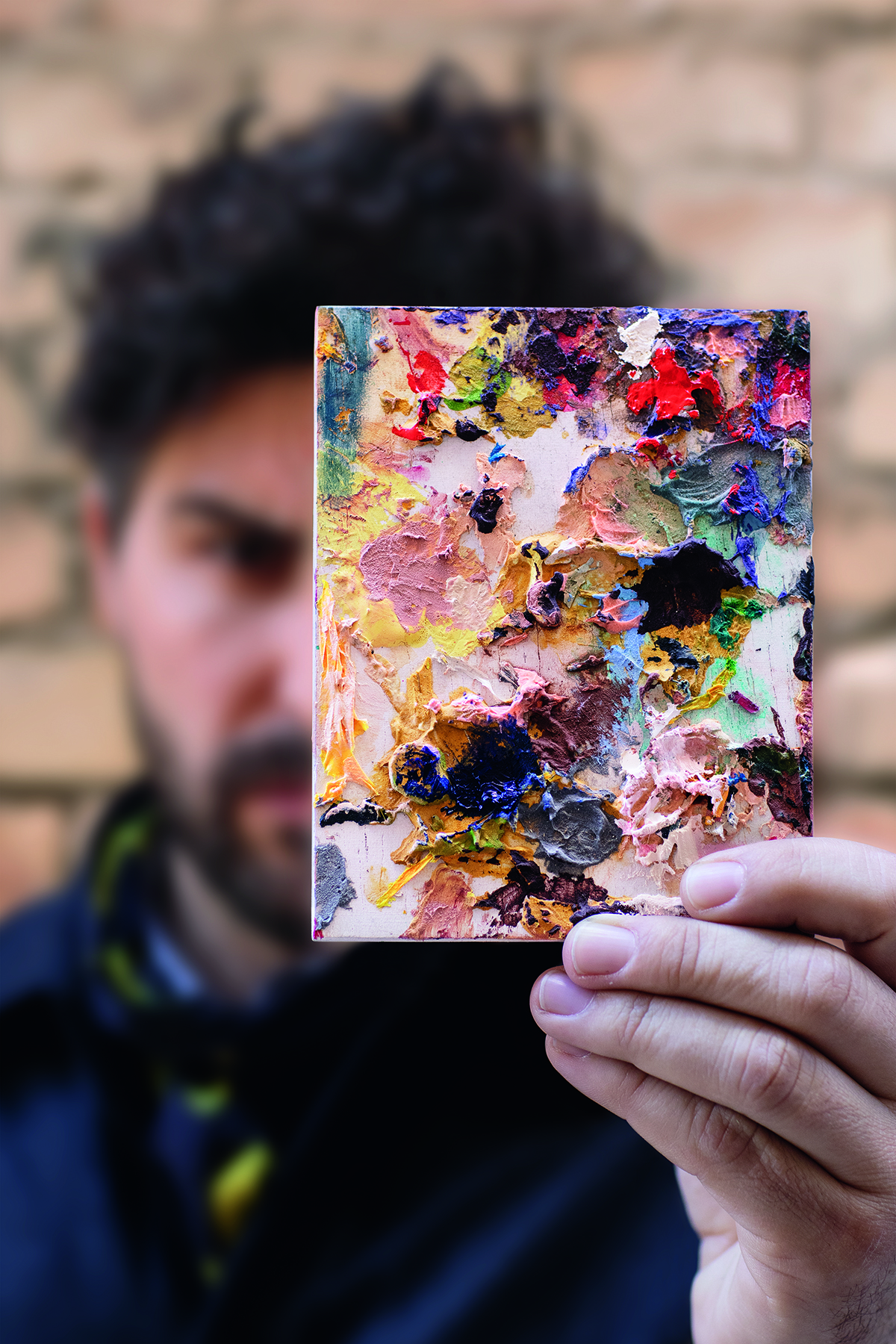
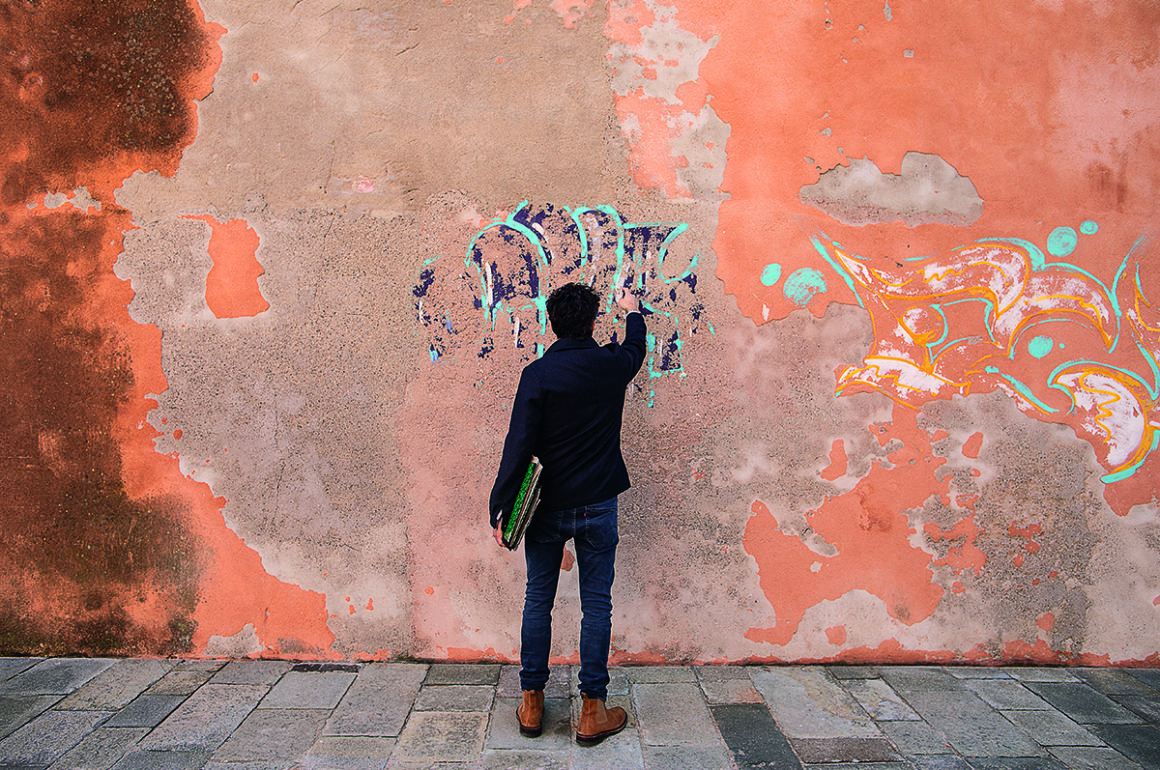
The artist Secundino Hernández in Venice, holding one of his preparatory studies for a larger palette painting
LUX Contributing Editor and photographer Maryam Eisler is entranced by Spanish artist Secundino Hernández. Here, she visits and photographs him on his residency in Venice to discuss inspiration and physicality in painting and the organised chaos of the creative process
Maryam Eisler: It is intriguing to hear about your visceral/carnal take on Venice; its tones and its ‘fleshiness’, as you call it.
Secundino Hernández: It was a coincidence. I only noticed it when I came here. I never had these memories about Venice before; I never thought about the colour of the buildings looking like flesh. It suddenly became evident as I looked out the window of my studio. I walk the city streets inspired, and I now combine the flesh tones by mixing them in the studio.
Maryam Eisler: What about the parallels with the work of L.S. Lowry?
Secundino Hernández: Yes, the palette! It’s amazing how Lowry developed his whole career with only five colours! The challenge is not to imitate, but to be inspired by his process. I have done this before with watercolours, based on Cezanne’s 14 colours.
Follow LUX on Instagram: luxthemagazine
Maryam Eisler: It’s interesting that you’re taking a figurative approach to painting in Venice. It seems to me that you are very much about this yin and yang, constantly meandering between lightness and heaviness; between monochromes and colour, the abstract and the figurative.
Secundino Hernández: Yeah. Someone asked me once, after I was done with these black and white works: “What is next?” and I said, “Back to the body.” It was shocking but it was true. After the freedom of the abstract paintings, I needed to go back to the exercise of representation. The mentality changes with the technique. It’s a new, open field for me. This is the most exciting part of painting. It’s not that I feel obliged to do this or that, but I push myself to try something new all the time. That’s what makes it rewarding.
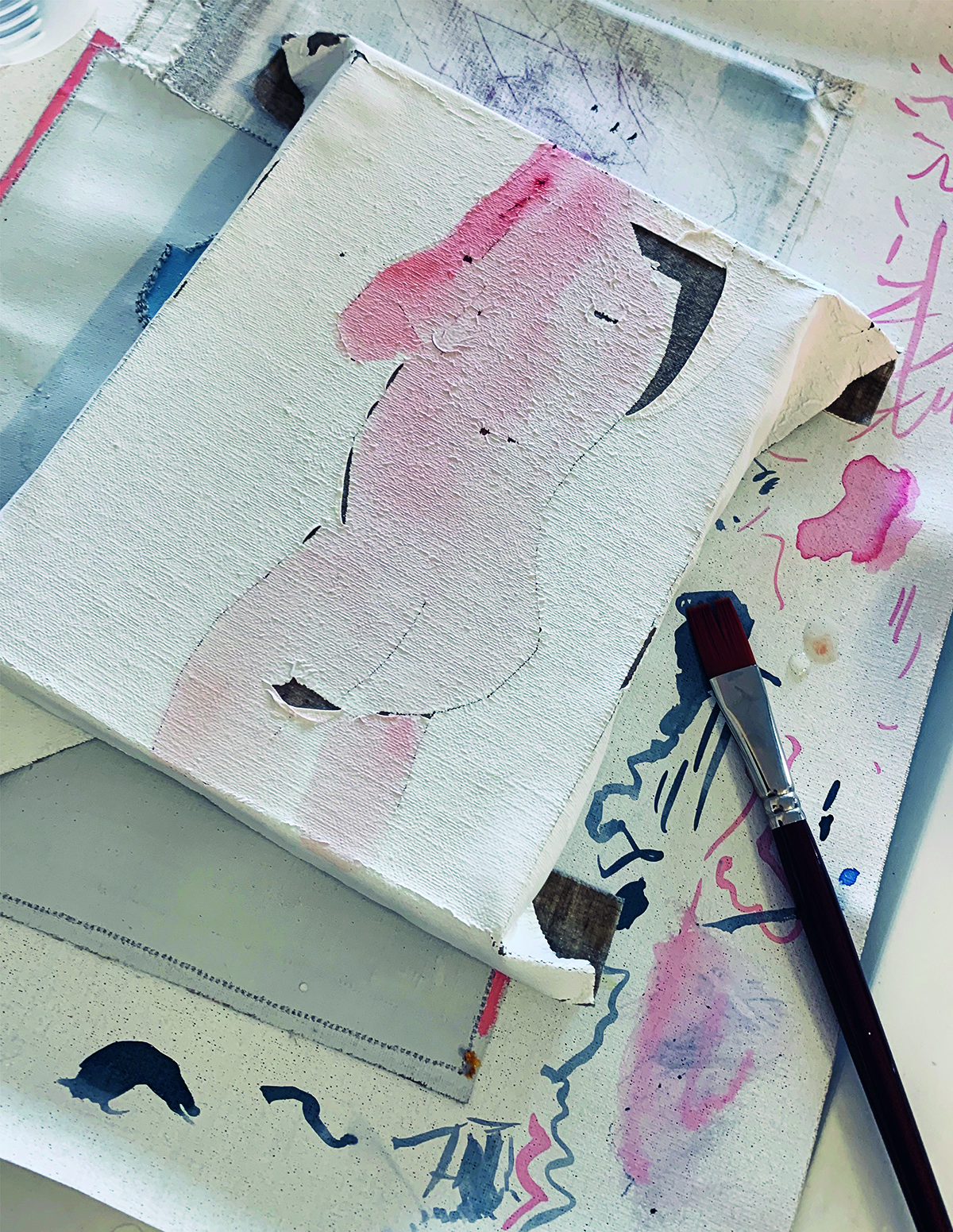
Maryam Eisler: You have taken an almost academic and art-historical approach to figuration; you even use a human model, although your figurative work is quite abstract.
Secundino Hernández: I want to explore how to paint figuration, after painting abstraction for a long time. It’s what I feel comfortable with. That’s why I paint with a model present and be academic in that way, but I always try to go a step further.
Maryam Eisler: So, you layer your work? You take all your past experiences, including the abstract, and layer it with the figurative. And then there’s magic…
Secundino Hernández: Yeah. I don’t move to figuration just for the sake of it. It’s about this inner exercise in order to see where the abstract works lead to. It’s like a mirror game. I want to test my abstraction, and for that, I need to have a reference, and that reference at this moment is the figure. This is the starting point for something new. The main thing is to open possibilities and new potential. I always thought it was easier to explain figurative work more than abstraction because abstraction is based on concepts, but I am realising that figures and bodies can also be very conceptual. We have seen the figure represented in paintings for centuries, so how do I paint a figure as if it’s being painted for the first time?
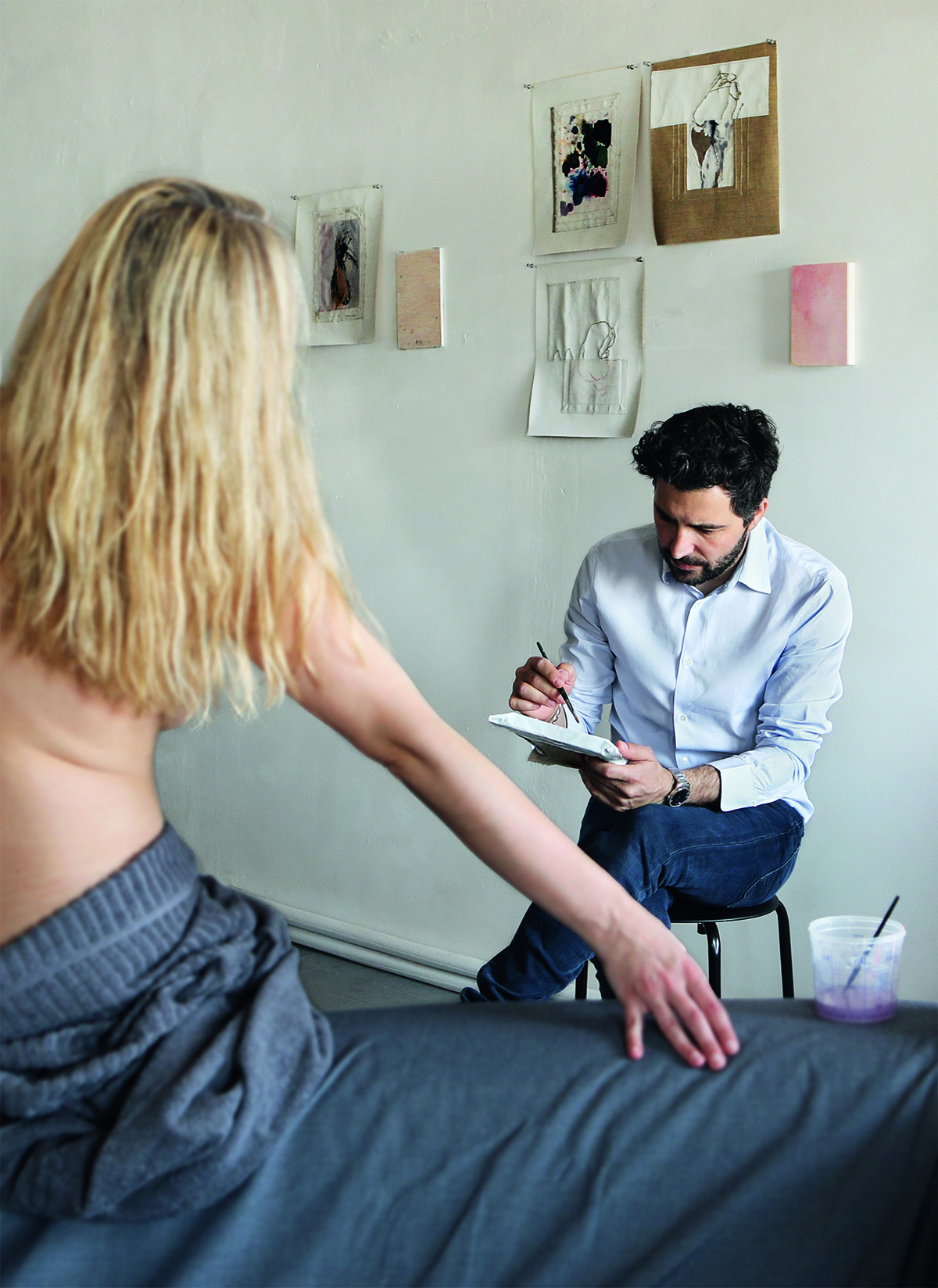
Hernández works with a live model to inform his figurative yet abstract works
Maryam Eisler: Going back to the language of the figurative and carnal, you often talk about ‘skin’ and ‘bones’, even with your abstract paintings. You scratch the surface of the painting like the surface of the skin and you dig deep into its bones.
Secundino Hernández: The pure linen is the bone because everything starts from this structure. I also like the idea of going backwards. It’s more like a sculpture, where you are sculpting and taking away from the form. Normally with a painting, you add to it. I like the idea of working with almost no paint at all, or even just with the primer.
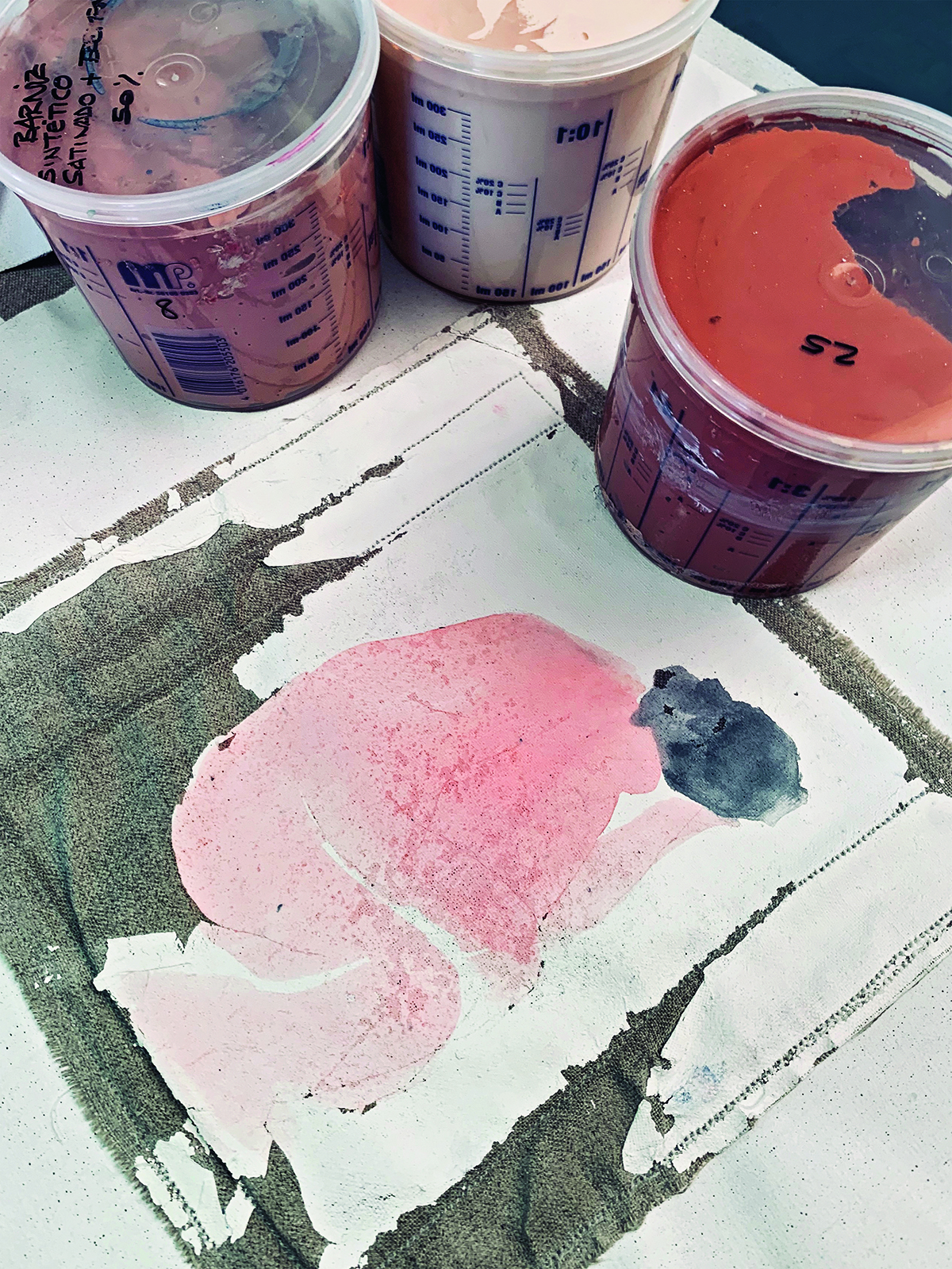
Maryam Eisler: You talk about ‘scars’ and you’re interested in dereliction. I see it so evidently as we walk through Venice. Anything that peels, anything that’s scratched, anything that has weathered texture to its surface. Is there an element of temporality and or timelessness in your work?
Secundino Hernández: Yes, that is very much present at the beginning of the palette works. They are nice to admire, but for me, they’re about the memory of what happens in the studio – every day, the process, the passage of time. I used a clean brush and I started to mix colours and they started to grow and grow and grow. I like this idea of growth and subtraction because the works are like pendulums. Some are about adding, and others are about taking away. Everything happens in between and in the physicality of the paintings.
Read more: Louis Roederer’s CEO Frédéric Rouzaud on art and hospitality
Maryam Eisler: Speaking of physicality, your act of painting is very physical, almost performative. You also ripple between large and small-scale works…
Secundino Hernández: It’s demanding. I like it now, but maybe in ten years’ time I will not have this energy level. It’s about not repeating the same process, the same scale. So, going back to the body, I thought it was nicer to paint on a small scale because it is more practical and, in a way, easier to develop the idea faster.
Maryam Eisler: In both your abstract and figurative work, in the way that you use the power-jet, the steamer, in the way that you peel and scratch the surface of the canvas, it seems to me that there is an element of chance and creative fate.
Secundino Hernández: It’s all about fate, you know. I believe that it’s got to be that way, otherwise I would never do any of it.
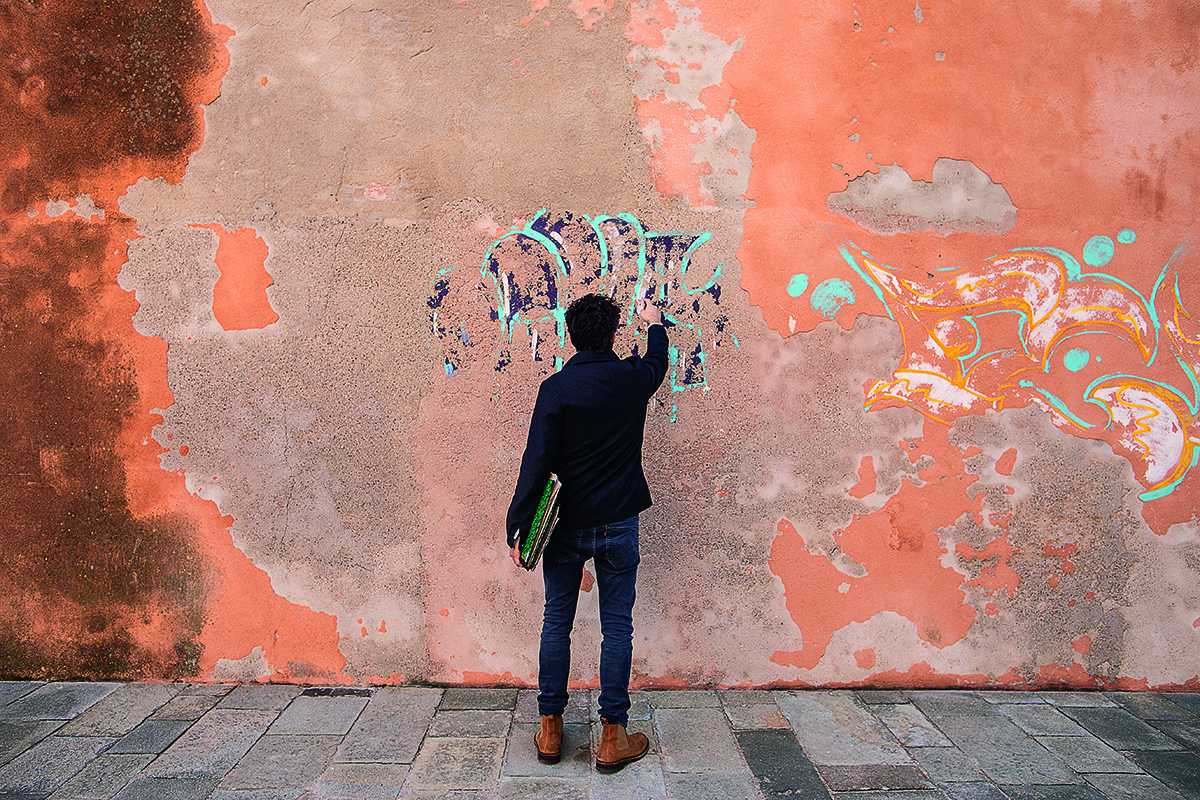
Hernández is inspired by derelict surfaces and the ‘fleshiness’ of the colours in Venice, such as this peeling wall and rows of buildings
Maryam Eisler: Does the sublime play a role in your practice? Spirituality, or just trust in the universal powers of being?
Secundino Hernández: It’s about reflection. When you work every day as I have for so many years, there needs to be something meditative and spiritual in the process.
Maryam Eisler: Primal?
Secundino Hernández: Yes. I’m a very primal person [laughs].
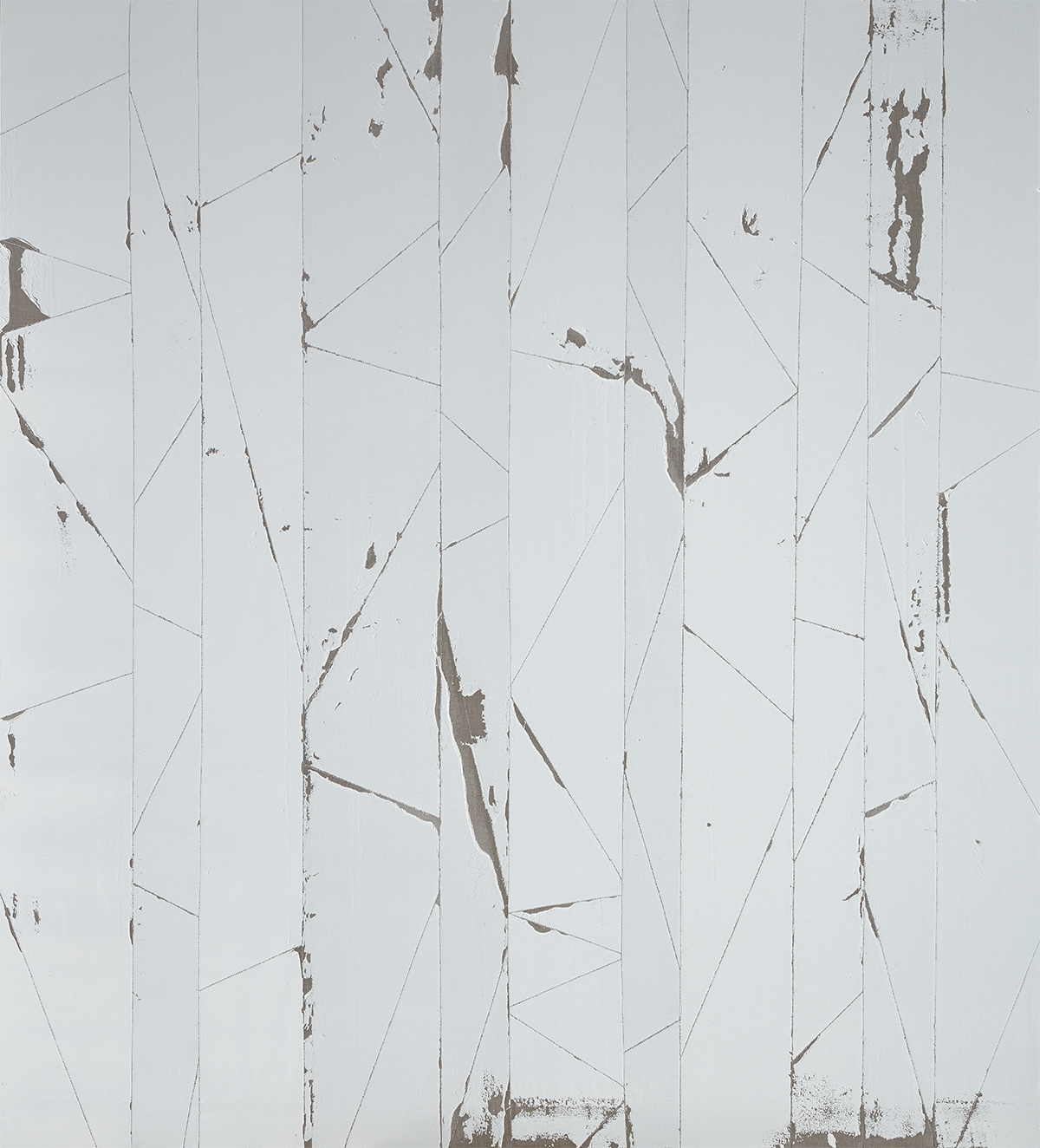
‘Untitled’ (2018), by Secundino Hernández, rabbit skin glue, chalk, calcium carbonate, titanium white on linen, 276 x 249 cm
Maryam Eisler: You also go from monochrome palettes to a plethora of colours. Is there something emotive going on when you do this ?
Secundino Hernández: Actually, it’s about practicality. When I go to the studio, I start mixing colours and I work on these palette works which have no limits. If I get a bit overwhelmed or stuck, I go back to the palettes. The palette works are always there because their physicality enables the creation of other paintings. Without them, the others don’t exist.
Maryam Eisler: Coexistence and codependence? From peace to chaos?
Secundino Hernández: Yes, but it’s organised chaos. I’m not that chaotic, as you see in this studio. I’m very tidy. The surface of the canvas, on the other hand, looks chaotic because I tried this and I continued with that; everything is very well planned, most of the time. I even do small sketches to plan it all out in advance. Especially for the large canvases – because if you start painting a 5-metre canvas like a crazy monkey, it’s going to be a crap painting.
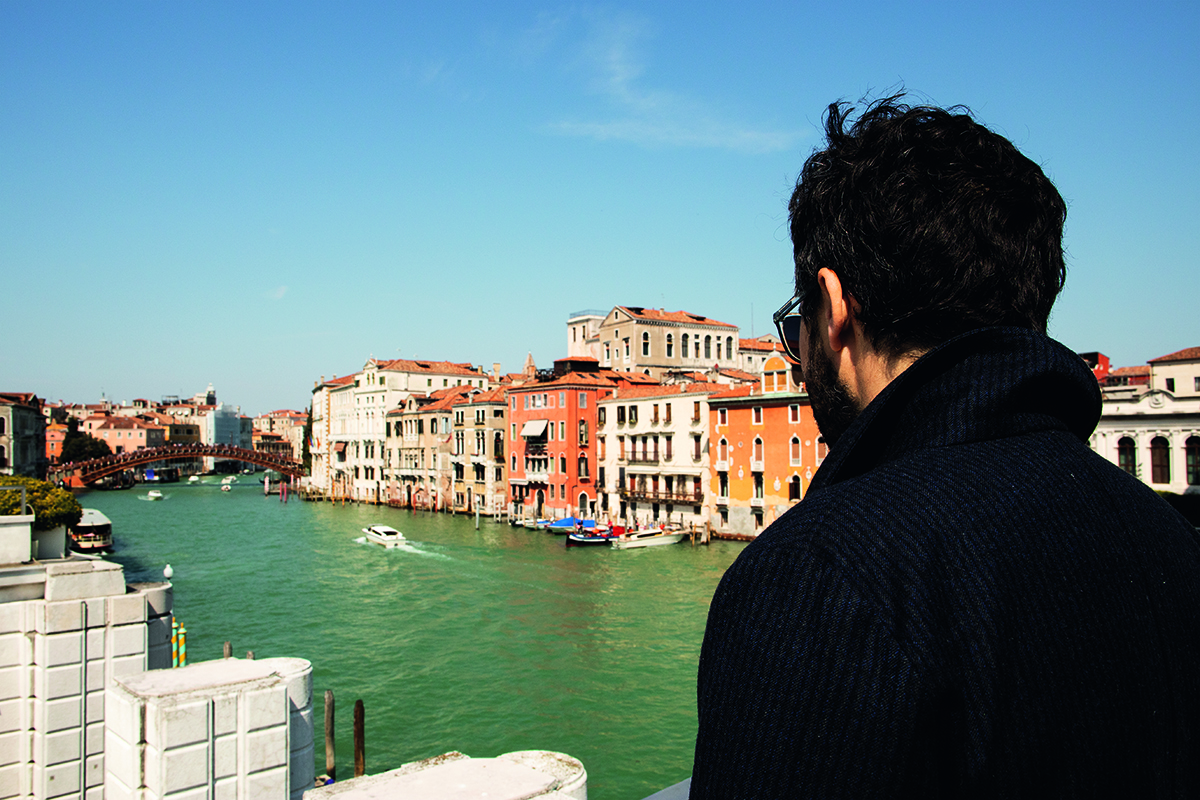
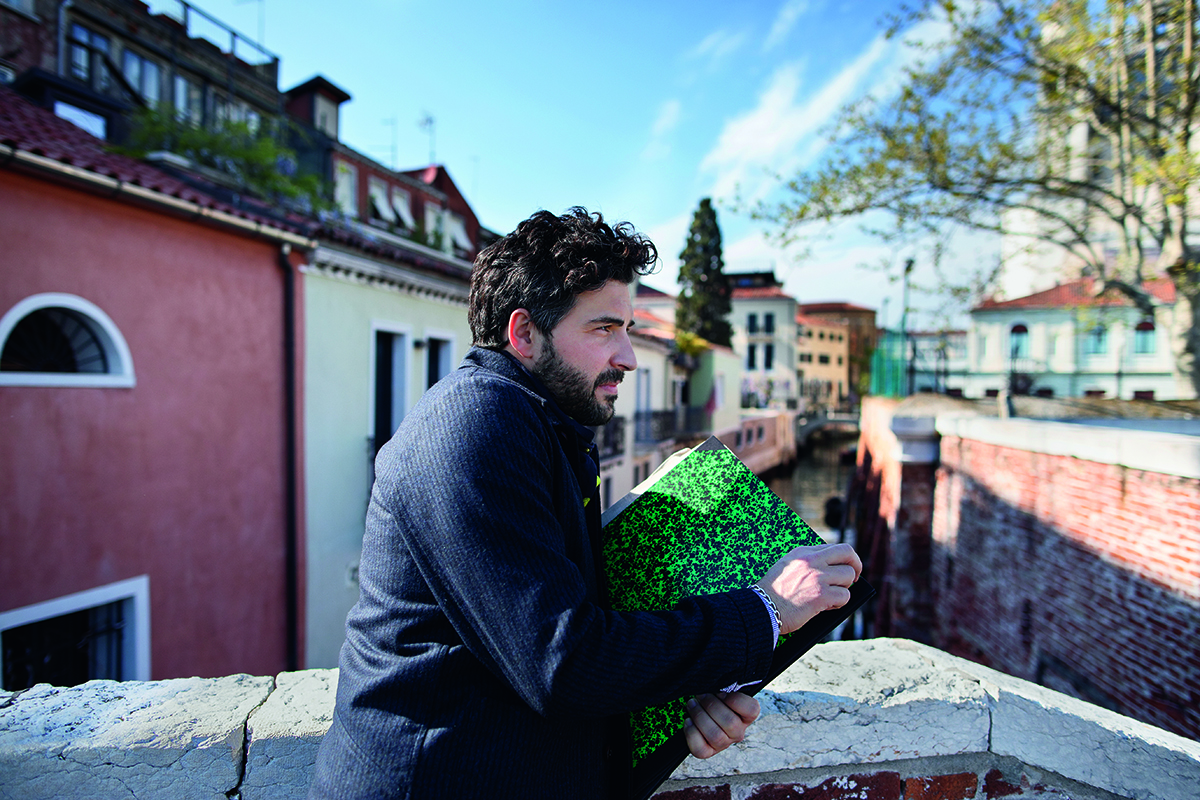
Hernández on a bridge near his temporary studio in the city. Above, on the roof of the Peggy Guggenheim Collection in Venice, overlooking the Grand Canal.
Maryam Eisler: You’re often compared to American Expressionists, such as Pollock.
Secundino Hernández: I think it’s fine, but I feel more comfortable with ‘slow motion’ Expressionism.
Maryam Eisler: Let’s talk about your studio and the lonely business of being an artist.
Secundino Hernández: It’s always a lonely business. Because right or wrong, you are the one and only final judge. And you have to trust yourself.
Read more: Spring Studios Founder Francesco Costa on creative networking
Maryam Eisler: How much work do you destroy?
Secundino Hernández: I try to be successful with everything. But if I do destroy work, I don’t think about it anymore. I learn from the failure and move on. Now, with age, something strange is happening. I sometimes struggle with my paintings and what I can’t control is the frustration. With age, your passion is meant to lessen. It’s not the case with me… it’s getting stronger every day, and I judge myself all the time. I always said there are no mistakes in painting. But how do you know when something is good or bad, right or wrong? It’s difficult. It’s about the relationship between your actions and what you present to the world. I guess I’m only human!
Maryam Eisler: Would it be fair to say that painting is about reality – your reality?
Secundino Hernández: Yeah. That’s the miracle of painting. With some dust and a little bit of egg, you paint something that never existed before. It’s amazing. This is the miracle of painting I think. Also, painting for me is a way of naively understanding the world. Here, with the act of painting, I see Venice with different eyes. I see its surface, its different skin colours and its many people.
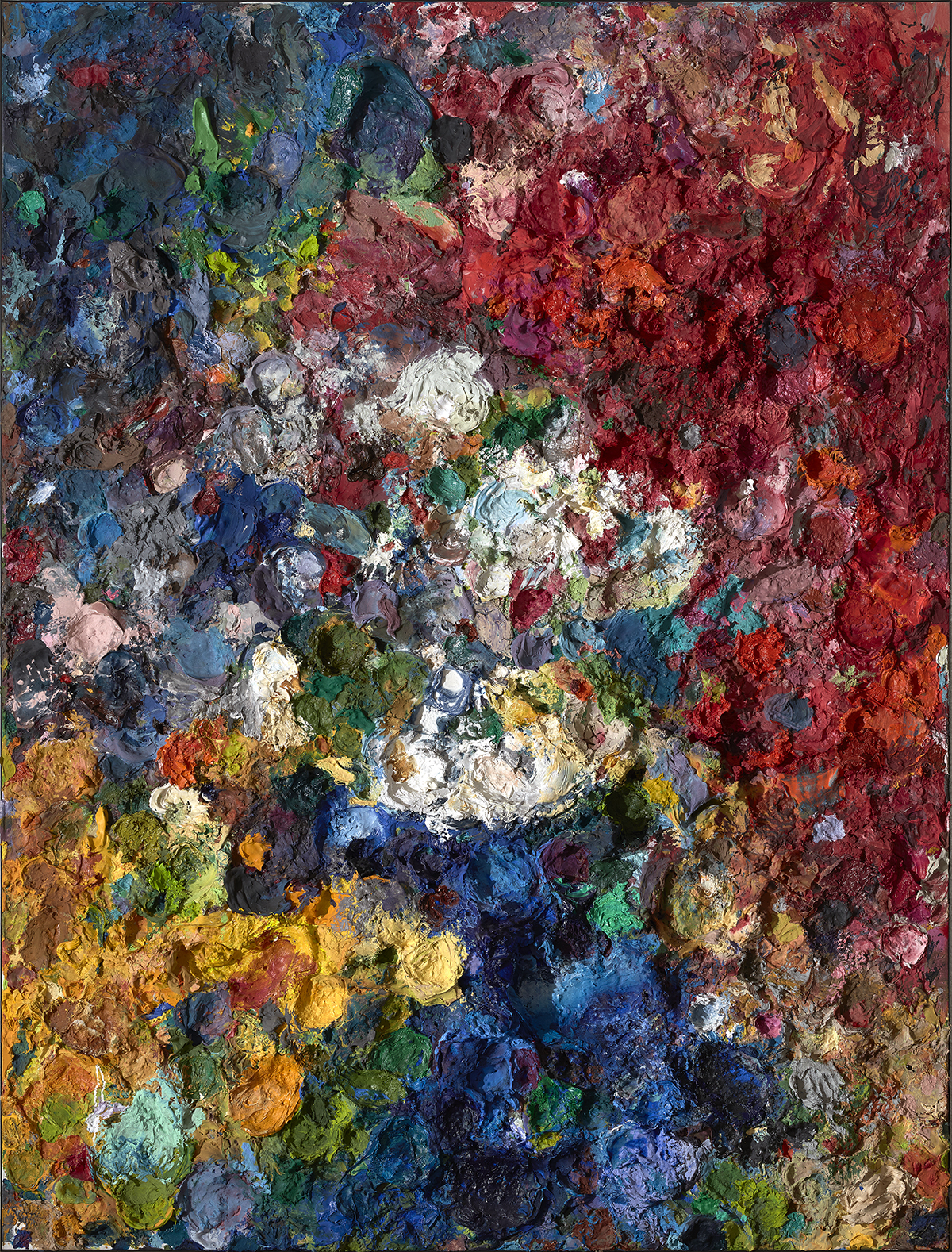
‘Untitled’ (2018), by Secundino Hernández, acrylic, alkyd and oil on linen, 261 x 196 cm
Maryam Eisler: What does it mean to be a painter in the 21st century?
Secundino Hernández: I don’t really know what it means. But I want my paintings to age in a timeless way. I want them to still feel fresh and talk to you in 40 years. This is the whole point. I may be asking for too much. But that’s what I am trying now and always will. Now, more than ever, I’m getting very ambitious. This morning, I was reading an article about Rembrandt and it said that the difference between Rembrandt and his contemporaries was that he not only was a great painter, technically speaking, but that he provided the figure with a certain life and soul. And that’s why his paintings look alive, even today. This is the point. And I was wondering if Rembrandt was even conscious of this. Maybe he was simply enjoying painting or maybe he was suffering and struggling as well, but it’s nice that at least someone writes in this way about your work, 300 or so years later.
Maryam Eisler: And the role of social media in the life of a 21st-century artist? Unlike most artists, you’re not present on social platforms?
Secundino Hernández: I’m not on Facebook and I’m not on Instagram. I have no time for that. Once I went on Instagram and I saw that there were 2,000 posts with my name, then I calculated, if you spend one minute per post, that’s 2,000 minutes of my time, which means two days of my life nonstop doing this sh*t. I just couldn’t do it. I prefer to sit and do nothing.
Maryam Eisler: Is it actually important for people, especially artists, to do nothing?
Secundino Hernández: It’s very important for everyone to be bored. I’m even making big efforts to check my mobile messages once or twice a day only. It’s difficult. It’s like cocaine. I feel like my brain needs it.
Secundino Hernández is represented by Victoria Miro Gallery. His latest exhibition runs at Victoria Miro Venice until 19 October. For more information visit: victoria-miro.com
This article was originally published in the Autumn 19 Issue.










Recent Comments